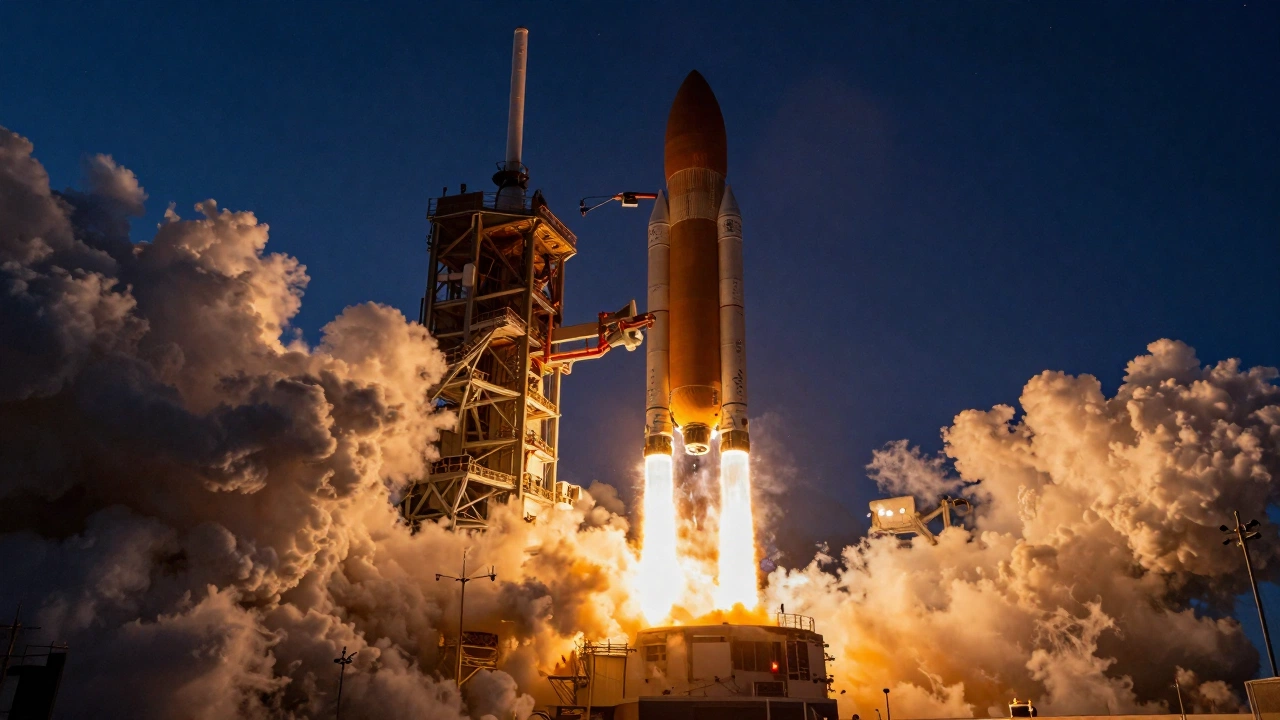
In the fast-moving technology world, few events capture imagination like a major space mission. NASA’s Artemis 2 launch on April 1, 2026, has done exactly that. The event ends a 53-year wait since the last time humans traveled beyond low Earth orbit. It represents real progress in spacecraft design, propulsion systems, and life support capabilities that could reshape our approach to exploration.
The Historic Launch of Artemis 2
The successful liftoff occurred at 6:35 p.m. EDT from Kennedy Space Center’s Launch Complex 39B atop the Space Launch System rocket. The Orion spacecraft, named Integrity, performed its critical translunar injection burn the next day. This placed it on a free-return trajectory toward the Moon. Early in the flight, the team addressed a helium pressurization glitch and a water valve problem. Both issues were resolved quickly without affecting the overall timeline or safety. The launch itself demonstrated years of engineering work coming together in one precise moment. This mission lasts about ten days and serves as a full systems test for technologies needed on longer journeys.
Experiments and Operations in Deep Space
Aboard the spacecraft, the crew conducts important scientific work that cannot be done closer to Earth. They have performed CPR and medical device checks in zero gravity to understand equipment behavior without gravitational assistance. Radiation shelter tests help identify effective protection strategies against cosmic rays. The AVATAR tissue-on-a-chip experiment provides unique biological data by observing living samples in the space environment. Photography sessions capture views of Earth and the surrounding void while public outreach activities keep people connected to the journey. By April 3, on flight day three, the spacecraft had already reached between 100,000 and 105,000 miles from Earth. These activities generate information that directly informs future mission planning.
The Upcoming Lunar Flyby and New Distance Record
The mission builds toward its lunar flyby on April 6 at an altitude between 4,000 and 6,000 miles. At its farthest point the spacecraft is expected to reach approximately 252,757 miles from Earth. This will break the record of 248,655 miles set by Apollo 13. The free-return trajectory adds a layer of safety because the spacecraft can loop back using natural orbital mechanics if propulsion systems encounter problems. Such features reflect careful engineering choices made to reduce risk on this first flight of its kind in decades. The data collected during this phase will be examined closely by engineers back on the ground.
Preparing Technology for Lunar Landings and Mars Missions
Every system tested during these ten days contributes to the larger Artemis program. Life support systems receive thorough evaluation under real deep space conditions. Navigation performance is measured across vast distances far from Earth’s protective magnetosphere. The re-entry phase will provide critical information about how the spacecraft handles high-speed return through the atmosphere. Splashdown is targeted around April 11 off San Diego. Success here builds confidence for crewed lunar landings in coming missions. Those landings aim to create a sustainable human presence on the Moon. The experience and data will eventually support even more ambitious goals of sending crews toward Mars. This step-by-step method turns ambitious ideas into practical reality through careful testing and incremental progress.