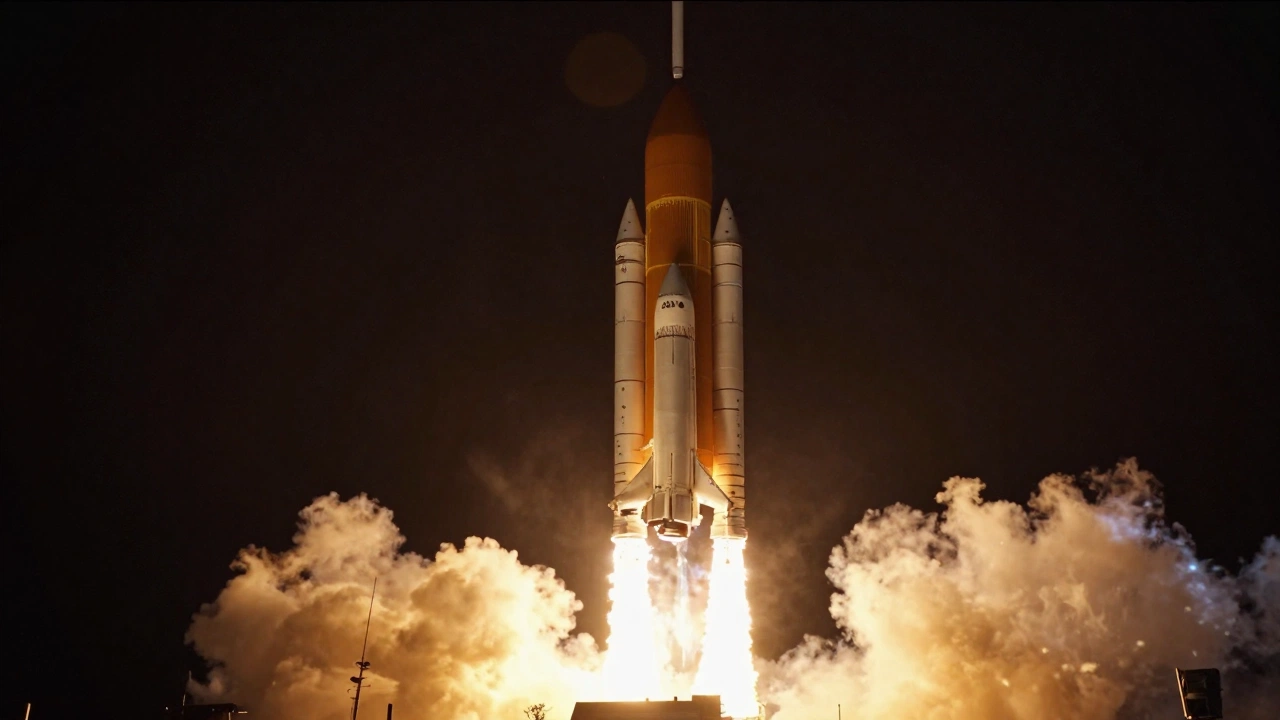
It’s an exciting time to be following technology and space exploration. NASA’s Artemis II mission launched aboard the Space Launch System rocket around April 1 or 2 2026. This approximately 10-day journey marks the first crewed lunar voyage in over 50 years since Apollo 17 in 1972. The mission focuses on a lunar flyby without landing to thoroughly test key systems in deep space conditions.
The Historic Artemis II Lunar Flyby Mission
Artemis II sends four astronauts on a path around the Moon to evaluate the Orion spacecraft’s life-support systems navigation and re-entry procedures. These tests prove essential for building confidence in hardware that will support more complex future operations. But the mission also represents a key step in the Artemis program aimed at creating sustainable human presence on the Moon by the end of this decade.
This effort opens doors for eventual Mars missions while strengthening ties with commercial partners working on lunar landers and habitats. The excitement around this flight feels similar to the anticipation that surrounded early space programs yet it carries modern expectations for international cooperation and technological precision. So far the mission has already generated considerable public interest as a true revival of crewed deep-space exploration.
Introducing the Diverse Artemis II Crew
Commander Reid Wiseman leads the crew alongside Pilot Victor Glover Mission Specialist Christina Koch and Mission Specialist Jeremy Hansen from the Canadian Space Agency. This team brings together extensive experience from various space agencies highlighting how collaborative today’s missions have become. Their work will deliver critical insights that shape the next generation of lunar and planetary travel.
Even far from Earth the astronauts dealt with a Microsoft Outlook hiccup that quickly became one of the mission’s viral moments. It serves as a reminder that everyday technical glitches can appear in the most extraordinary environments. Yet the crew stayed focused on their primary objectives demonstrating remarkable adaptability during this historic flight.
Revolutionary Optical Wireless Technology Emerges
While attention centers on space University of Cambridge researchers unveiled a laser-powered optical wireless system published March 11 2026 in Advanced Photonics Nexus. The innovation uses a compact 5×5 array of vertical-cavity surface-emitting lasers mounted on a sub-millimeter chip. This setup achieves an aggregate 362.7 Gbps using 21 of the 25 lasers with individual speeds ranging from 13 to 19 Gbps.
The technology consumes roughly half the energy of leading Wi-Fi systems at 1.4 nanojoules per bit. During tests over a 2-meter link it delivered high uniformity above 90 percent through microlens arrays while supporting multi-user access with minimal interference. Such performance could ease radio spectrum congestion in homes offices data centers and hospitals.
Researchers including Hossein Safi and Harald Haas contributed to this project which offers improved security over traditional wireless methods. Rather than replacing Wi-Fi the system works alongside it providing efficient high-speed options where they are needed most. This kind of advancement arrives at a perfect moment as demand for reliable connectivity continues to grow across industries.
AI Innovations and Big Tech Corporate Shifts
OpenAI has stayed prominent in recent headlines after acquiring the popular tech talk show and podcast TBPN in a move some described as chasing vibes. The purchase attracted criticism regarding the company’s merger strategy. Around April 3 Fidji Simo took medical leave prompting leadership changes as OpenAI shifts focus toward coding tools enterprise products and deeper integrations while facing competition from other players.
Microsoft launched a mid-class AI model due to ongoing compute limitations and continues aggressive infrastructure investment including a reported 10 billion dollar AI push with SoftBank in Japan that boosted stocks like Sakura Internet. Their Copilot product shows solid sales traction even as concerns mount about rising data center costs and potential AI bubble risks. These developments reflect the intense pace of innovation across the sector.
Tesla reported one of its weakest quarters for vehicle deliveries in years during the first three months of 2026 leading to a significant stock drop. The company now emphasizes its AI future with robotaxis and the Cybercab while reports suggest the final days of Model S and X production may be approaching. This pivot underscores how rapidly priorities can shift in the automotive and technology intersection.
Record Funding Chip Sector Gains and Global Risks
Global startup funding reached a record approximately 297 billion dollars in the first quarter of 2026 heavily driven by AI progress in models compute and infrastructure. The chip sector is experiencing strong growth with Samsung Electronics expected to post a massive quarterly profit surge and Chinese chip firms hitting record revenues fueled by the AI boom together with U.S. export curbs.
Yet challenges persist amid geopolitical tensions from the U.S.-Iran conflict. The Islamic Revolutionary Guard Corps has threatened attacks on major tech companies including Apple Google Microsoft Nvidia IBM and Tesla. At the same time cybersecurity experts report supply-chain attacks by North Korean hackers that compromised the LiteLLM open-source AI library affecting multiple startups and exposing vulnerabilities in widely used software.